
How it works
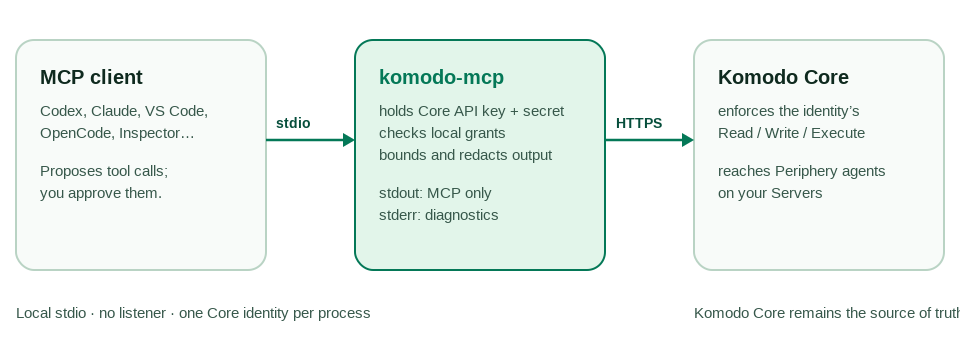
The three parts
Section titled “The three parts”- Your MCP client starts a child process over stdio or sends authenticated requests to a persistent HTTP service. The client and its model propose tools for your approval.
- komodo-mcp is a Rust executable built on the official rmcp 3.11.0 SDK. It holds one Core API key and secret, decides which tools this process exposes, validates arguments, and turns Core responses into bounded, redacted, typed results.
- Komodo Core is called through the official
komodo_client2.3.2 crate. Core authenticates the key, enforces that identity’s permissions, and reaches Periphery agents on your Servers.
Startup
Section titled “Startup”- The process reads its Core credentials, transport settings and local grants from the environment. Invalid configuration fails before the startup probe.
- It sends one authenticated
GetVersionread and keeps the observed Core version. A failure exits nonzero with a safe stderr diagnostic and no stdout. - Only then does it serve MCP. The repository’s compiled-stdio tests use protocol
2025-11-25.
A tool call
Section titled “A tool call”- Discovery.
tools/listreturns the tools enabled for this process: tools eligible under the local grants and included by the instance’s tool selection. Discovery, lookup, and dispatch share one router, so a disabled or unknown tool is rejected before its arguments are even parsed. - Validation. List and detail inputs are strict JSON objects. Unknown fields, out-of-range page sizes, conflicting selectors, and similar mistakes fail with
invalid_argumentsbefore Core is called. - Resolution. Detail tools resolve an exact, case-sensitive name or a stable 24-character ID to one visible resource. Ambiguous or incomplete resolution fails safely and asks you to retry by ID.
- Core requests. Reads use Core’s typed read API. Changes use typed write or execute requests, only after the local grant and any required preview or acknowledgement. Each request has a 5-second connection timeout and an independent 15-second deadline; redirects are not followed.
- Projection. Results are fixed, documented fields. Raw configuration, environment blocks, Compose content, upstream error bodies, and credential values never enter them. Large evidence such as logs and diagnosis is bounded and marked truncated.
- Result. Success is returned as structured content plus matching JSON text. Failures use MCP’s
isErrorresult with a stablekindsuch aspermission_deniedortimeout.
Operations are receipts, not guarantees
Section titled “Operations are receipts, not guarantees”When an operation is enabled and approved, komodo-mcp submits it once and returns Core’s update receipt. Submission, the final execution outcome, and workload health are separate facts. Use wait_for_update to observe a known update ID, and reconcile_operation to look for a possible match after a lost reply. Neither tool resubmits anything.
What this site is built from
Section titled “What this site is built from”This website is a static Astro Starlight site in the repository’s website/ directory. Operator guides and README sections are rendered from the versioned Markdown at build time, and versions shown here are read from Cargo.toml and rust-toolchain.toml.